
Skip to content
LegalGuideIPTV Basics

Is IPTV Legal? The Complete 2026 Guide

Published: 8 min read
Share:

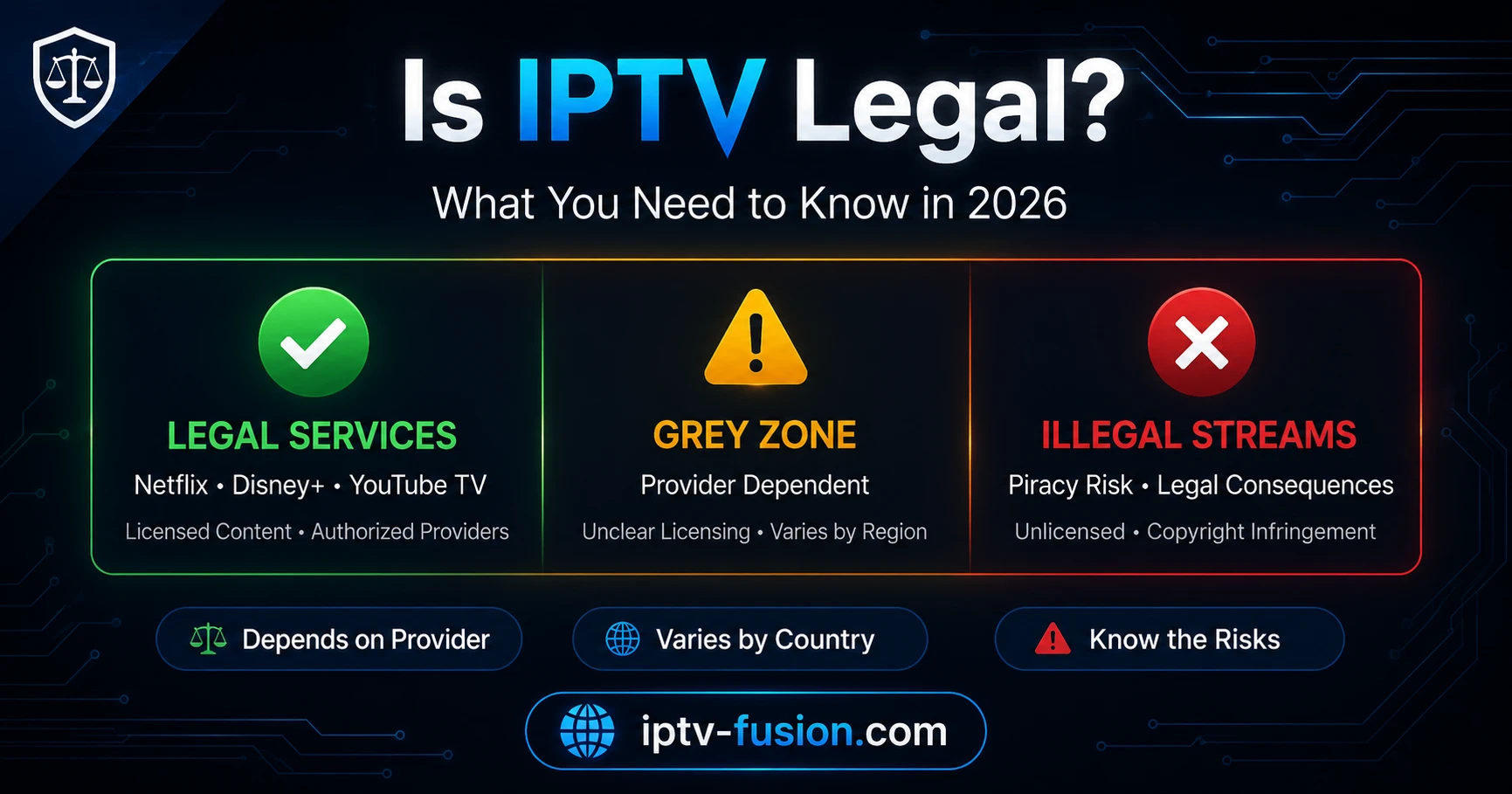
Yes, IPTV is legal. IPTV is simply a technology for delivering television over the internet — the same technology that powers Netflix, Disney+, YouTube TV, and Hulu. What determines legality is not the technology itself but whether the provider holds the proper licences for the content it streams. Licensed services are fully legal; unlicensed services that resell channels without permission are not. This guide explains exactly where the line is and how to stay on the right side of it.
Is IPTV legal explained 2026
Image: Is IPTV legal? Legal vs illegal IPTV services explained for 2026

What Is IPTV, Exactly?

IPTV stands for Internet Protocol Television. Instead of receiving TV signals through a cable line, satellite dish, or aerial antenna, IPTV streams channels and video content over your internet connection. It is, in technical terms, identical to how every major streaming service works.

When you watch Netflix, you are using IPTV. When you stream a live game on YouTube TV or a show on Hulu + Live TV, you are using IPTV. The technology is mature, legal, and used by some of the largest media companies in the world. The confusion arises entirely from a separate category of third-party services that offer enormous channel counts at suspiciously low prices — and it is those services, not the technology, that raise legal questions.

IPTV technology is unambiguously legal in the United States, the UK, the EU, and virtually every country. There is no law anywhere that makes streaming television over the internet illegal. What matters is the licensing status of the specific service you use.

Think of it like a record shop. Selling music is legal. Selling bootleg copies of music without the rights holder's permission is not. The shop — the delivery mechanism — is fine. The question is whether what's being sold inside is properly licensed. IPTV works exactly the same way: the delivery method is legal, and the legality of any given service depends on whether it has secured the rights to the content it broadcasts.

The distinction between a legal and an illegal IPTV service is usually easy to spot once you know what to look for. Here is a clear comparison:

IndicatorLegal IPTVIllegal IPTV
Content licensingHolds rights to what it streamsResells channels without permission
Company detailsRegistered, verifiable, contactableAnonymous, no real address
Payment methodsCredit card, PayPal, standard processorsCryptocurrency only, no receipts
PricingFair market rateSuspiciously cheap (every channel for the price of a coffee)
SupportReal support team you can reachNone, or disappears when contacted
Terms & policiesClear Terms of Service, DMCA policy, refund policyNone
App availabilityWorks with established appsRequires sideloading unknown software

The simplest rule of thumb: if a service offers every premium channel, every sports package, and every pay-per-view event on earth for the price of a single coffee per month, it almost certainly does not hold the licences to do so legally. Legitimate licensing costs money, and that cost is necessarily reflected in fair pricing.

What Are the Risks of Using Illegal IPTV?

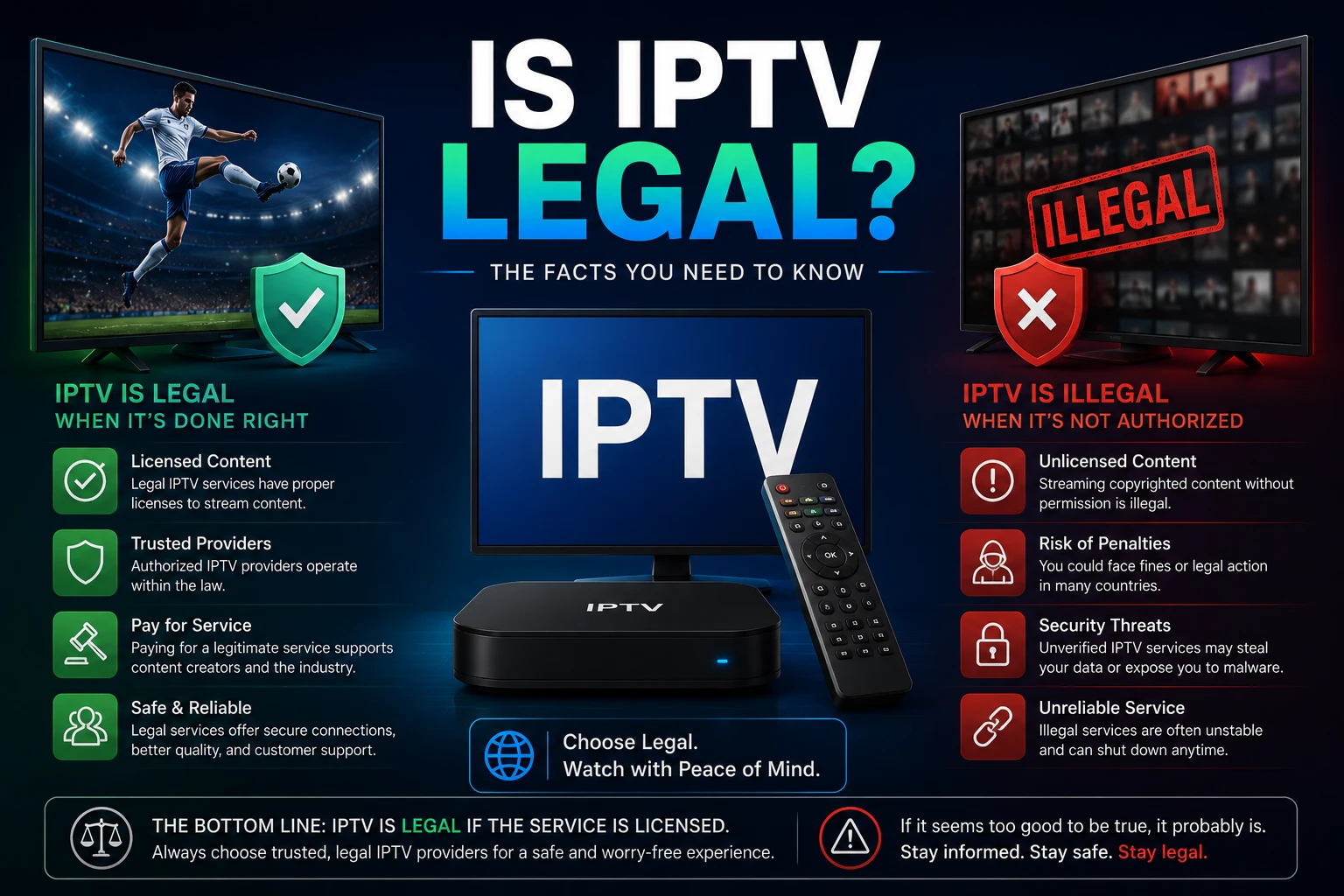
Using an unlicensed IPTV service exposes you to several genuine risks that go well beyond the legal question:

  • Legal exposure: In most countries, knowingly accessing pirated content is a civil or criminal matter. While enforcement overwhelmingly targets the operators rather than individual viewers, the legal grey area is one you don't need to enter.
  • ISP warnings and throttling: Internet providers in many countries monitor for known piracy streams and may issue warning letters or slow your connection.
  • Malware and security threats: Pirate IPTV apps are not available in official app stores. You have to sideload them from unknown sources, and security researchers have repeatedly found malware, keyloggers, and crypto-mining code bundled inside these apps.
  • Zero reliability: Illegal services are routinely shut down by enforcement actions, often without warning — frequently right before a major sporting event when you most want them to work.
  • No refunds, no recourse: When an illegal service vanishes, so does your money. There is no support desk, no refund policy, and no one to hold accountable.
Risks of illegal IPTV malware legal
Image: The hidden risks of illegal IPTV — malware, legal exposure, and no reliability

Can You Get in Trouble for Watching IPTV?

For viewers, the practical risk is low but not zero. In the United States and most of Europe, enforcement is directed at the people who operate and distribute illegal streams — not at individuals watching them. There are no laws in the US that specifically prohibit watching an IPTV stream, and prosecutions of ordinary viewers are extremely rare.

That said, "low risk" is not the same as "no risk," and it certainly isn't the same as "smart." The malware threat alone is a compelling reason to avoid pirate services, and the unreliability makes them a poor experience regardless of the legal question. The simplest way to eliminate every one of these concerns is to use a properly licensed provider. You pay a fair price, you get reliable service, and you never have to think about any of this.

Yes. IPTV Fusion is a fully licensed streaming service. We work exclusively with authorised content distributors and comply with all applicable laws in every jurisdiction we operate in. Our service includes everything you'd expect from a legitimate provider:

  • A registered company with public, verifiable contact details
  • A clear Terms of Service, Privacy Policy, and DMCA policy
  • Secure payment processing via PayPal, credit card, and regulated gateways
  • A real 24/7 support team reachable via WhatsApp and Telegram
  • A 7-day money-back guarantee on every plan
  • Transparent, fair pricing with no hidden costs

You can compare these markers against any service you're considering. If a provider can't tick these boxes, that tells you what you need to know.

Choosing a legal, trustworthy IPTV service comes down to a short checklist. Before you subscribe to anything, verify the following:

  1. Check the pricing is realistic. Fair pricing reflects real licensing costs. If it's too cheap to be true, it is.
  2. Look for a registered company. A legitimate provider publishes contact details and a real business presence.
  3. Confirm standard payment methods. Credit card and PayPal mean a real payment processor has vetted the business. Crypto-only is a warning sign.
  4. Read the policies. A real Terms of Service, refund policy, and DMCA policy signal a business operating in the open.
  5. Test the support. Contact support before buying. A legitimate service answers.
  6. Use a free trial. A provider confident in its service offers a risk-free way to test it.

For an authoritative overview of how copyright applies to streaming, the U.S. Copyright Office is a useful reference. For European viewers, the Wikipedia overview of IPTV explains the technology and its legitimate uses in detail.

IPTV is completely legal when you use a licensed provider. The technology is the same one behind Netflix and YouTube TV; the only thing that matters is whether your specific service holds the rights to the content it streams. Look for transparent pricing, real support, verifiable business details, and clear policies — these are the hallmarks of a legitimate provider.

IPTV Fusion ticks every one of those boxes. If you want to enjoy thousands of channels and a vast on-demand library with complete peace of mind, start a free 24-hour IPTV Fusion trial — no credit card required. You can also explore our subscription plans or read our comparison of IPTV vs cable TV to see why so many households are making the switch.

Frequently Asked Questions

Is IPTV legal?
Yes. IPTV technology is completely legal — it is the same technology behind Netflix, Disney+, and YouTube TV. Legality depends on whether the provider holds proper content licences. Licensed providers like IPTV Fusion operate fully within the law.
How do I know if an IPTV service is legal?
Legal IPTV services have a registered company, transparent fair pricing, standard payment methods (credit card, PayPal), a real support team, and clear Terms of Service and refund policies. If a service offers everything for the price of a coffee with no contact details, it is not legal.
Can I get in trouble for watching IPTV?
Enforcement targets the operators who distribute illegal streams, not individual viewers. Prosecutions of ordinary viewers are extremely rare. However, using a properly licensed provider eliminates the legal grey area entirely, along with the malware and reliability risks.
Is IPTV Fusion a legal service?
Yes. IPTV Fusion is a fully licensed streaming service with a registered company, clear Terms of Service and DMCA policy, secure payment processing, 24/7 support, transparent pricing, and a 7-day money-back guarantee.
What are the risks of using illegal IPTV?
Illegal IPTV apps often contain malware, keyloggers, and crypto-mining code. Your ISP may issue warnings or throttle your connection. The services are unreliable and frequently shut down without warning — and when they vanish, your money goes with them.